Why are there different techniques?
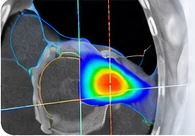
The team must decide precisely where the radiation should go and how surrounding organs will be protected. The names refer to different ways of shaping the beam, checking position or managing movement. They are not simply a ranking from “basic” to “best”.
3D conformal radiotherapy
Three-dimensional planning uses CT images to define a target and organise radiation beams around it. It remains an appropriate and effective technique for many situations.
IMRT: intensity-modulated radiotherapy
IMRT varies the strength of radiation across each beam, making it possible to shape the dose more closely around complex targets. It may help reduce the dose received by nearby sensitive structures, but it is not needed in every case.
VMAT: radiotherapy delivered while the machine rotates
VMAT is a form of IMRT in which the treatment machine moves around the patient while adjusting radiation delivery. It can deliver complex plans efficiently, depending on the clinical situation.
IGRT: image-guided radiotherapy
IGRT refers to images used at or near treatment time to check the patient’s position and, when necessary, adjust it. It is a safety and accuracy tool that can be combined with 3D, IMRT or VMAT.
What if a tumour moves when I breathe?
For some chest or abdominal targets, breath-hold, four-dimensional CT or other motion-management methods may help the team plan for movement.
What about brachytherapy and stereotactic treatment?
Brachytherapy places a radiation source inside or close to the treatment area in selected circumstances. Radiosurgery and SBRT use highly focused treatment for well-defined targets, and are explained in more detail in the separate guide on ablative radiotherapy.
How is the technique chosen?
The most appropriate option depends on the diagnosis, target shape, surrounding organs, previous treatment and intended benefit. A more complex technology is not automatically the right choice for every patient.
For further details, read our focused guide to ablative radiotherapy and radiosurgery.
Treatment options are complementary
3D, IMRT and VMAT describe ways of delivering and shaping external radiation; IGRT is the imaging used to verify positioning and may be combined with them. Electron beams are sometimes used for superficial targets. Brachytherapy places a source inside or close to the target and may require a separate procedure.